Blog
PK 8303 – Where Were The Safety Nets?


Safety and Its Evolvement
Aviation is considered to be the safest mode of travel among all modes of travel, based on the mortality rate. By virtue of the complexity of operations involved during aviation flying, safety is always put at the top of the checklist of every aviation organization.
There were days when aircraft accidents used to occur frequently, and there was a reason for that. Earlier, the safety systems were not defined properly, and so much was evolving at the same time. The earlier approach in aviation history was reactive, as people knew little, and they used to react to the situations accordingly. At that time, technology was raw, and most of the accidents were attributed to technology. The trend continued till the 50’s when man started improving the technology.
Safety Started Evolving
The era from the ’50s to the ’90s witnessed a paradigm shift when technology grew astronomically. The concept of safety improved with better investigation models. No wonder technology made things easier, but the human was and remained the weakest link in any chain of events. As technology outsmarted humans, human error cases started taking their toll. It was when people realized that humans tend to commit mistakes if not contained in time. With improvements in the areas of investigations, the need for a Safety Management System (SMS) came that finally materialized in 2013. All commercial airlines are now bound to have a Safety Management System within their organizations.
Safety Nets on PK 8303
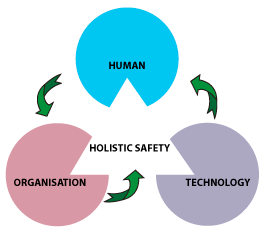
Safety Management System brought the concept of safety nets. These nets aimed to contain errors and violations in the systems to improve the safety standards of the aviation industry. A typical holistic approach in aviation safety runs along three sides of a triangle, where humans are at one corner. Technology on the second corner, and organization at the third corner of the triangle.
What About PK 8303?
Aircraft systems, Training, Safety systems; all have matured. We have come out of the times of blaming humans or technology. Things have changed now. In the present day safety concepts, any occurrence or accident attributable to human error is to be blamed on the organization, not the individual(s) involved. It is the organization that fails to monitor the deviations. Most of the time, those deviations are accepted as the norm. Such norms become the culture of the organizations.
It is not blaming the Pilot or the Air Traffic Controller. It’s about questioning the organizations with which these people belonged. The safety nets in these organizations failed to identify deviations on the part of those humans. If the organizations do not monitor, identify, and curb such unacceptable tendencies among the personnel, be it a pilot, maintenance engineer, air traffic controller, or any person directly or indirectly involved with the aircraft, then the losses are catastrophic, and that’s what happened in the case of PK-8303.
It must be borne in mind that accidents do not occur in isolation. The last pin is nailed in the coffin when all the safety nets fail. Last-minute actions in the cockpit of PK-8303 suggest that such procedural violations must have occurred earlier as well but somehow got managed by the aircrew. It can also be inferred that such close calls, even reported after the flight, were never taken seriously by these organizations, not for the purpose of penalization but for improvement.
Read More: A brief history of flight and flight safety
Like in the past accidents in Pakistan, again, Safety remained confined to the pages with no effective implementation. The frequency of air accidents in Pakistan in recent years is a clear depiction of the ineffective implementation of the State Safety Program and the independent Safety Management Systems of the local operators.
What is Needed in the Future?
The crash of PK-8303 is a sheer outcome of an organizational failure. Safety is a culture. What is needed in the future is to maintain strong monitoring control through the State Safety Program (SSP) and the Safety Management System (SMS) Program, respectively. There is also a need for an effective reporting and follow-up system by the Safety and Quality Departments to identify and contain the undesired human deviations through effective safety nets at the regulatory and operating organization level.
Written by guest writer, Faisal Bashir